Agentic coding tools consume far more tokens than traditional chat interfaces. Inference speed directly affects developer productivity.
A developer using Cursor, Cline, or Codex CLI typically consumes 500K to 2M tokens per day. Agentic workflows are token-intensive: the AI reads files, plans changes, writes code, runs tests, encounters errors, and iterates. Each step requires a round-trip to the inference API.
The impact of inference speed on wait time:
- At 90 tokens/second (typical frontier model): 1M tokens = ~3 hours of inference time
- At 400+ tokens/second (MiniMax-M2.5): 1M tokens = ~42 minutes of inference time
The difference is substantial: faster inference means less time waiting for responses and more time in productive flow.
This article explains why agentic coding has different performance requirements than chat-based AI tools, and how to optimize for speed.
Why Agentic Coding Tools Consume So Many Tokens
Chat-based AI tools typically involve a single request-response cycle per interaction.
Agentic coding works differently. A single task like "refactor this module" triggers dozens of LLM calls. The agent reads files, builds context, plans an approach, writes code, runs tests, encounters errors, debugs, and iterates. Each step requires an inference round-trip.
A single task breaks into two distinct phases:
Planning phase (5-15 turns):
- Understand the codebase structure
- Analyze dependencies and architecture
- Design migration strategy
- Assess risks and edge cases
Execution phase (50-200+ turns):
- Read and analyze files
- Write diffs, apply changes
- Run tests, capture failures
- Fix errors, iterate until green
| Pattern | Turns | Tokens/Session | Wait Time (90 tok/s) | Wait Time (400 tok/s) |
|---|---|---|---|---|
| Chat completion | 1-3 | 2-5K | seconds | seconds |
| RAG pipeline | 3-5 | 10-30K | minutes | seconds |
| Agentic coding | 50-200+ | 500K-2M | hours | minutes |
To put these numbers in context: a simple chat completion uses 2-5K tokens and completes in seconds regardless of inference speed. A RAG pipeline uses 10-30K tokens and takes a few minutes at slower speeds, or just seconds at higher throughput. Agentic coding is where speed becomes critical — with 500K to 2M tokens per session, the difference between 90 tok/s and 400+ tok/s translates to hours versus minutes of total inference time per task.
Planning benefits from model intelligence. Execution benefits from speed. Execution typically accounts for 90%+ of total tokens.
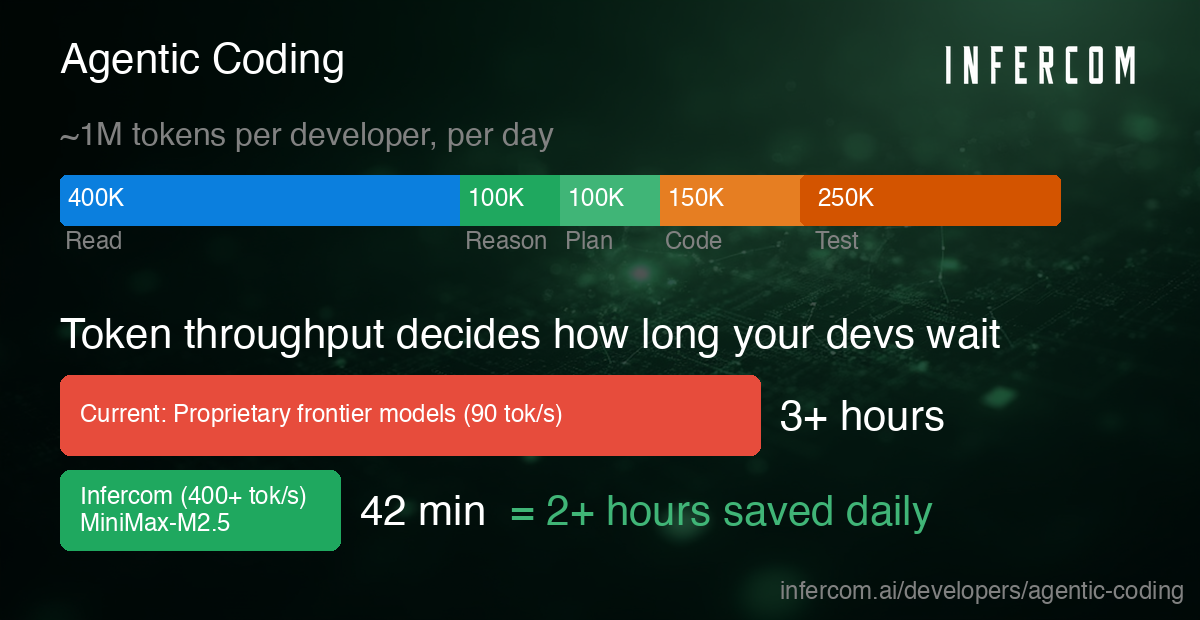
Token Consumption in a Typical Agentic Coding Session
Here's a breakdown of token usage for a typical agentic coding task:
Scenario: Refactor a module across 5 files, add tests, fix CI failures
- Read operations: ~50K tokens
- Planning: ~20K tokens
- Code generation: ~100K tokens
- Test generation: ~50K tokens
- Error iteration (3 rounds): ~80K tokens
- Total: ~300K tokens
At different speeds:
| Provider | Speed | Time | Developer Experience |
|---|---|---|---|
| Claude Sonnet | 60-90 tok/s | 55-83 min | Likely context switch |
| GPT-4o | 80-100 tok/s | 50-62 min | Likely context switch |
| MiniMax-M2.5 on Infercom | 400+ tok/s | 12 min | Can maintain focus |
For a 300K token task, Claude Sonnet at 60-90 tok/s requires 55-83 minutes of inference time. GPT-4o at 80-100 tok/s is slightly faster at 50-62 minutes. MiniMax-M2.5 on Infercom at 400+ tok/s completes the same task in approximately 12 minutes. This 4-5x speed difference determines whether developers can maintain focus on a task or need to context-switch while waiting.
At 300K tokens per task, the difference between 12 minutes and 55+ minutes of inference time is significant for developer workflow.
Inference speed affects how developers interact with AI tools. With fast responses, developers can iterate quickly in short cycles. With slow responses, developers tend to context-switch to other tasks while waiting, which has its own productivity costs.
Two Approaches to Faster Agentic Coding
There are two main approaches to improving inference speed for agentic coding tools:
Option A: Full Replacement
Use MiniMax-M2.5 for everything. This is the simplest setup:
- One model, one provider
- 75.8% SWE-bench verified — matches frontier performance
- 400+ tokens/sec on EU infrastructure
- Simplest configuration, lowest cost
Best for: Teams optimizing for speed and simplicity
Codex CLI config (Full Replacement):
# ~/.codex/config.toml
model = "MiniMax-M2.5"
model_provider = "infercom"

[model_providers.infercom]
name = "Infercom (EU Sovereign)"
base_url = "https://api.infercom.ai/v1"
env_key = "INFERCOM_API_KEY"
wire_api = "responses"
Option B: Planner/Executor Split
Keep your frontier model (Claude, GPT, Gemini) for complex planning decisions. Route execution to fast inference.
The pattern breaks down like this:
| Phase | Turns | What Happens | Model Priority |
|---|---|---|---|
| Planning | 5-15 | Understand codebase, architecture decisions, migration strategy, risk assessment | Quality (frontier model) |
| Execution | 50-200+ | File reads, diffs, tests, failures, fixes, iteration | Speed (fast model) |
The planner/executor split recognizes that planning and execution have different requirements. Planning involves 5-15 turns where the model analyzes the codebase, makes architectural decisions, and assesses risks — tasks that benefit from frontier model reasoning capabilities. Execution involves 50-200+ turns of file operations, code generation, testing, and iteration — tasks that benefit primarily from speed. Since execution accounts for the vast majority of tokens, routing it to a fast model like MiniMax-M2.5 significantly reduces total inference time while preserving frontier-quality planning.
90%+ of your tokens go to execution, not planning. Route those to fast inference.
Best for: Teams already invested in a frontier model who want to optimize the bulk of their token spend
Cline config (Planner/Executor Split):
In Cline settings, enable "Use different models for Plan and Act modes":
- Plan Model: Claude Sonnet (or your frontier model)
- Act Model: MiniMax-M2.5 via Infercom API
OpenCode config:
// opencode.json
{
  "agent": {
    "plan": {
      "model": "claude-sonnet-4-5-20250514",
      "provider": "anthropic"
    },
    "build": {
      "model": "MiniMax-M2.5",
      "provider": "infercom"
    }
  }
}
Codex CLI Configuration for Infercom
Codex CLI is OpenAI's open-source agentic coding assistant. Configuration for Infercom:
Prerequisites:
- Node.js 18+
- Infercom API key (get one here)
Installation:
npm install -g @openai/codexSet your API key:
export INFERCOM_API_KEY="your-key-here"
# Add to ~/.zshrc or ~/.bashrc for persistence
Create config file (~/.codex/config.toml):
# Default settings
model = "MiniMax-M2.5"
model_provider = "infercom"
approval_mode = "suggest"  # Options: suggest, auto-edit, full-auto

# Infercom provider definition
[model_providers.infercom]
name = "Infercom (EU Sovereign)"
base_url = "https://api.infercom.ai/v1"
env_key = "INFERCOM_API_KEY"
wire_api = "responses"
Verify setup:
codex
# Should show:
# model: MiniMax-M2.5
# provider: infercom
Pro tip: Pro tip: Codex CLI uses the Responses API (/v1/responses), not Chat Completions. Infercom supports both.
How Inference Speed Affects Developer Workflow
Beyond raw time savings, inference speed affects several aspects of the development workflow.
Context switching costs: Short wait times (under 30 seconds) allow developers to stay focused on the current task. Longer waits often lead to context switching, which has its own productivity overhead when returning to the original task.
Iteration frequency: Faster inference makes experimentation more practical. Developers can try multiple approaches quickly, catching issues earlier in the development cycle.
Feedback loop size: Fast responses enable working in smaller increments. Smaller changes are generally easier to review, test, and merge.
Team-level impact:
For a 5-person team where each developer saves 2 hours per day of inference wait time, that's 10 hours daily or about 200 hours per month.
At a fully-loaded cost of €80/hour, that represents €16,000/month in engineering time that can be redirected to productive work.
The productivity impact scales with team size and the volume of agentic coding tasks.
EU Data Residency and GDPR Compliance
For teams with data residency requirements, the location of inference infrastructure matters.
MiniMax-M2.5 on Infercom runs on:
- SambaNova hardware in Munich, Germany
- Full GDPR compliance
- No US CLOUD Act exposure
- ISO 27001 certified infrastructure
For teams in regulated industries (finance, healthcare, legal, government), EU data residency may be a compliance requirement.
Performance and sovereignty:
EU-hosted inference has historically been associated with slower performance compared to US-based providers.
MiniMax-M2.5 on Infercom demonstrates that high throughput (400+ tok/s) is achievable on EU infrastructure. This removes the traditional trade-off between data sovereignty and inference speed.
Getting Started
To try Infercom with your agentic coding tools:
- Get an API key at cloud.infercom.ai/apis — includes free credit to start
- Configure your tool — Infercom supports Codex CLI, Cline, Cursor, and other OpenAI-compatible tools
- Test with a real task — use an actual development task to evaluate the performance difference
For detailed setup instructions for each tool, see our agentic coding documentation.
The configuration process typically takes a few minutes.
API verification:
curl -s https://api.infercom.ai/v1/responses \
  -H "Authorization: Bearer $INFERCOM_API_KEY" \
  -H "Content-Type: application/json" \
  -d '{"model":"MiniMax-M2.5","input":"Write a Python function to reverse a string"}' \
  | jq '.output[0].content[0].text'
Summary
Agentic coding tools have fundamentally different performance requirements than chat-based AI interfaces due to their high token consumption.
Inference speed directly impacts developer productivity through reduced wait times and tighter feedback loops.
MiniMax-M2.5 on Infercom offers 400+ tok/s throughput, 75.8% SWE-bench accuracy, 160K context window, and EU data residency.
For teams evaluating inference providers for agentic coding workloads, throughput should be a primary consideration alongside model quality and data residency requirements.
Written by Thomas Vits, with assistance from AI.